The American Dream
In our interview with ROCKSTAR GAMES, the team behind GRAND THEFT AUTO VI reflects on Florida, satire, and building worlds players never want to leave.
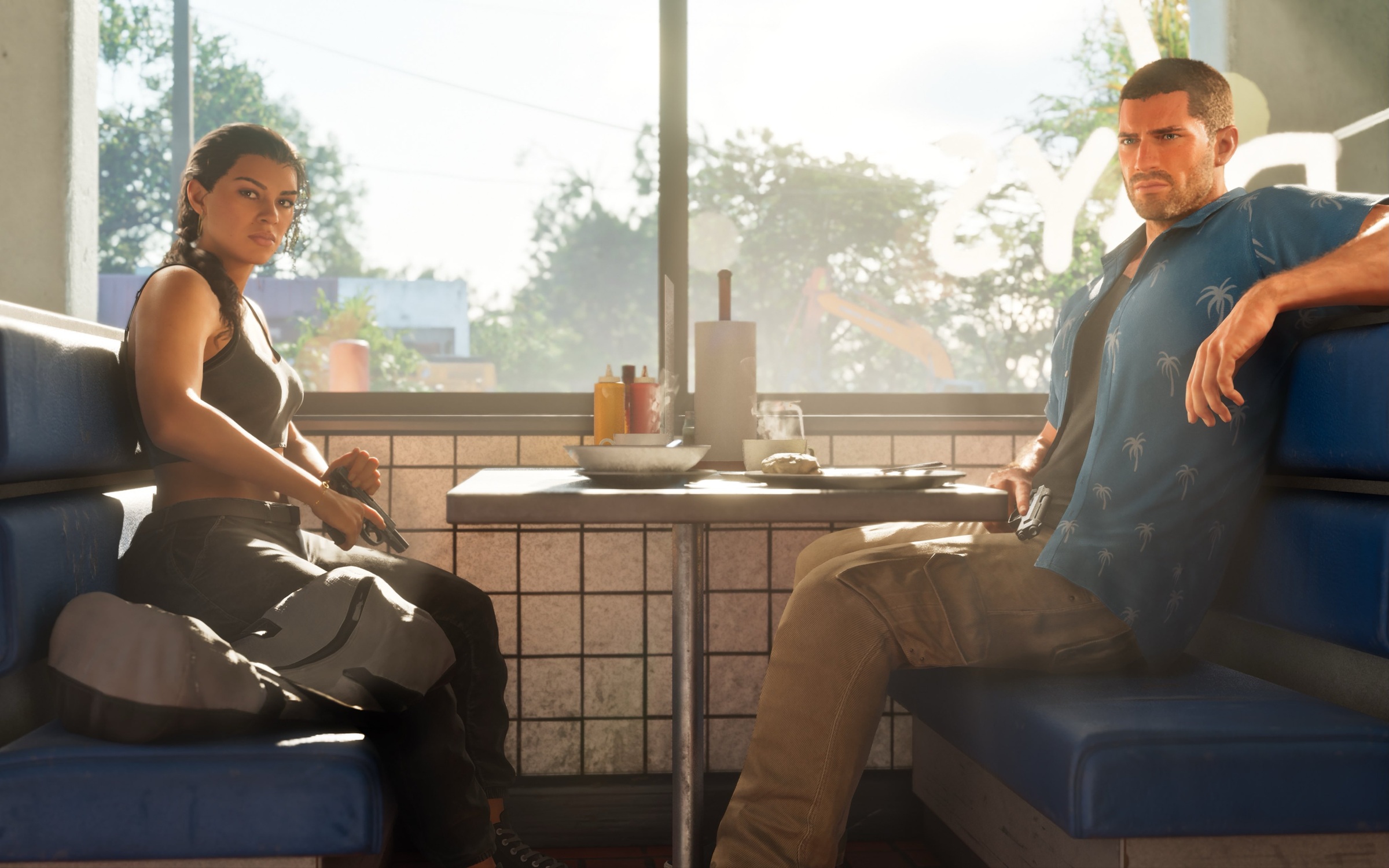
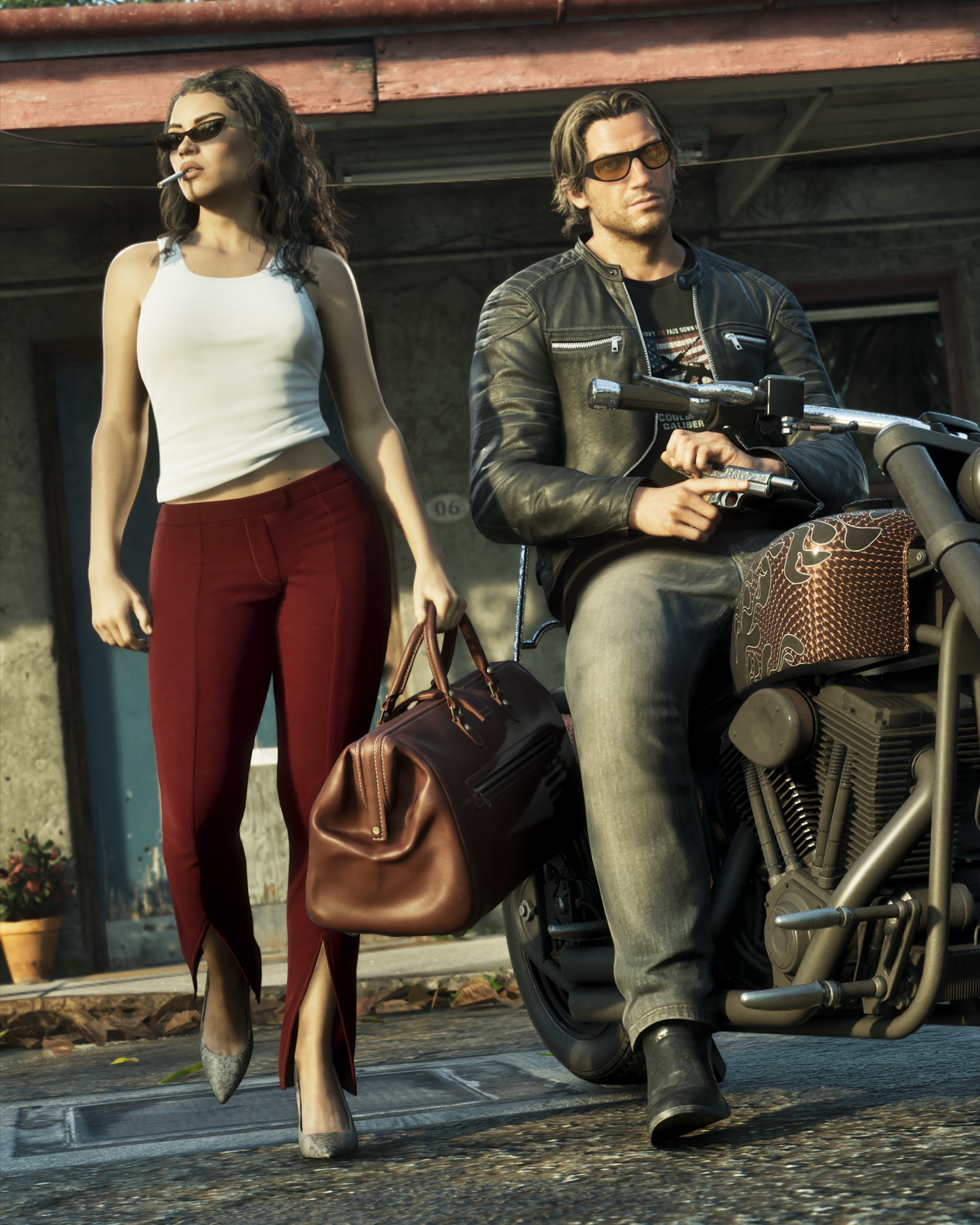
Starring LUCIA CAMINOS and JASON DUVAL
Words KACION MAYERS
Artwork ROCKSTAR GAMES
“We hope people will want to escape into these worlds and these characters—to get lost with them and in them.”
Nowadays, a storyline can be generated in seconds, its script finalised soon after. In a world where the feeling of a place, down to the specific shade of a sunset, can be assembled from a desk on another continent, the creatives who still take the time to handcraft every element stand apart.
Rockstar Games, creators of the Grand Theft Auto series, have built worlds that feel just as much like a place to visit as a game to play for nearly three decades; their signature attention to detail at every level defines the experience. With titles that consistently expand on what’s possible when gameplay and storytelling are intertwined, they pursue one idea: that games can be more.
This takes time: it’s 29 years since the first Grand Theft Auto. They’ve spent nearly all of the 13 years since the last iteration building a new, singular world: Grand Theft Auto VI. Many projections suggest the game will transcend the medium to become the biggest entertainment launch of all time.
This brand-new story—a GTA love story—places players in the roles of Lucia Caminos and Jason Duval, two lovers on the run across the state of Leonida, Rockstar’s take on modern Florida. It’s their deepest and most immersive experience to date, promising a completely new approach to everything they’ve ever worked on. In their own words, it’s the ultimate version of an unfolding body of work—one that pushed games to the centre of modern culture in the process.
In a sweeping interview, the people behind the vision reflect on a decade-long creative process, including development decisions, research trips across southern Florida, how they maintain the series’ notoriously satirical tone, and much more. Here, LOVE showcases the endless hours of gameplay that await a world that will soon recalibrate its relationship with time—the ultimate luxury.
KACION MAYERS What makes video games unique as an art form? What considerations do you make when trying to create a piece of art that lets you both avoid reality and confront it head-on?
ROB NELSON (Head of Development/Co-Studio Head, Rockstar North): The interactive nature of games, the ability to craft an experience where players can inhabit an imaginary world, and share in a journey with a character or characters, all of that is unique to games as a medium. If we do our jobs well, it can provide an incredible sense of immersion and connection to the world and characters we have created. Our job is to entertain people, so any considerations we make about the experience always begin with that in mind. We hope people will want to escape into these worlds and these characters—to get lost with them and in them.
Sometimes you need things to feel realistic to help with that sense of immersion, and conversely, sometimes you need to forego realism in favour of what will be most convenient for the player—realism can help greatly with immersion, but too much can feel tedious, so we try to find the right balance.
Sometimes drawing an amusing or poignant parallel to some aspect of the real world is helpful in supporting the experience, and sometimes it’s better to ignore or omit certain aspects of reality because they just don’t make sense with the experience we are trying to create. Everything we do is done to support the sense of being immersed in a world, connecting to its characters and the narrative we are weaving through it.
KM How do you approach and manage the development process for a game that requires years of obsessive detail?
RN In the case of Grand Theft Auto, once we decide on a location for the game world, we start our research in the city or state we have chosen as inspiration. Once we have spent enough time there getting a real sense of place, we begin to determine which areas and locations we want to include, what sort of people we want to meet, and what sort of player-character-set will be best suited to take us credibly through the broadest range of experiences. We lay out a rough narrative and begin plotting out major story beats on the map.
Our senior team has been working together for a looooooong time. Everyone has a good sense of what they need to do and how they want their areas of the game to evolve. We start building and creating assets and systems, and we begin roughing in content across all areas of development. We build the game up through a series of eight-week milestones where we pull agreed-upon sections of the game together. We evaluate those milestones and make loads of notes that will determine what we focus on for the next milestone. We work our way there, year after year, one obsessive day at a time, course-correcting as we go; always with the feeling we want the finished game to have firmly in mind, knowing that often we have to find that feeling, and trusting that, even if we haven’t found it yet, we will eventually! Our process is highly iterative. Even though our team has grown substantially over the years, it is still of paramount importance to us that our games feel tonally consistent and are executed with a singular creative vision.
KM Tell me about your Florida research trips. How have they inspired the world that you’ve built in-game? (What type of notes are you taking? What kind of places are you visiting? Who do you speak to? Could you share one revealing takeaway or anecdote from your time in Florida?)
AARON GARBUT (Head of Development and Co-Studio Head, Rockstar North): Every game we make starts with research trips. It’s where we get to explore both the place and our ideas as a group. We do multiple trips. We start small with just a few of us, figuring out what we are trying to make and what experiences and locations stand out, then we come back with more and more of the team and layer on more research and organisation.
To begin [on GTAVI], a small group of us spent some time travelling from Miami through some of the surrounding towns and through the Florida Keys down to Key West. This is one of the best parts of the entire project: a car full of friends, driving for days on end, talking about what we want to make and being immersed in the locations and our ideas.
We return to some of the places we go and the people we meet, with the larger team. I’m sitting with a camera and a phone, just constantly recording. On initial trips we don’t tend to go as in-depth in the research; we are just experiencing the place. Then we come back in greater numbers and go deeper.
From the start, Florida spoke to us. Me and some of the art directors spent a day literally hanging out of the side of a helicopter, filming the Everglades and the city from the air. Flying low and fast over the mangrove inlets and high over downtown and the beach. We ended up hovering over
“We took things that interested us, like the conspiracy theories, the strange ways the public reacts to everyday occurrences. Those are the things we ran with.”
a stadium with a concert on—it turned out to be Beyoncé; I think we made the local news the next day.
We do go in-depth, we hang with locals, and we hear lots of stories and learn as much as we can. We travel around with cops and with gang members. Everyone is lovely. Some people are equally scary. We experience the underside as well; although the people who showed us around were among the nicest we’ve met, the stories, the places, and the details could be terrifying. We try to build a world that is believable and varied, with depth, and so that’s the research we need.
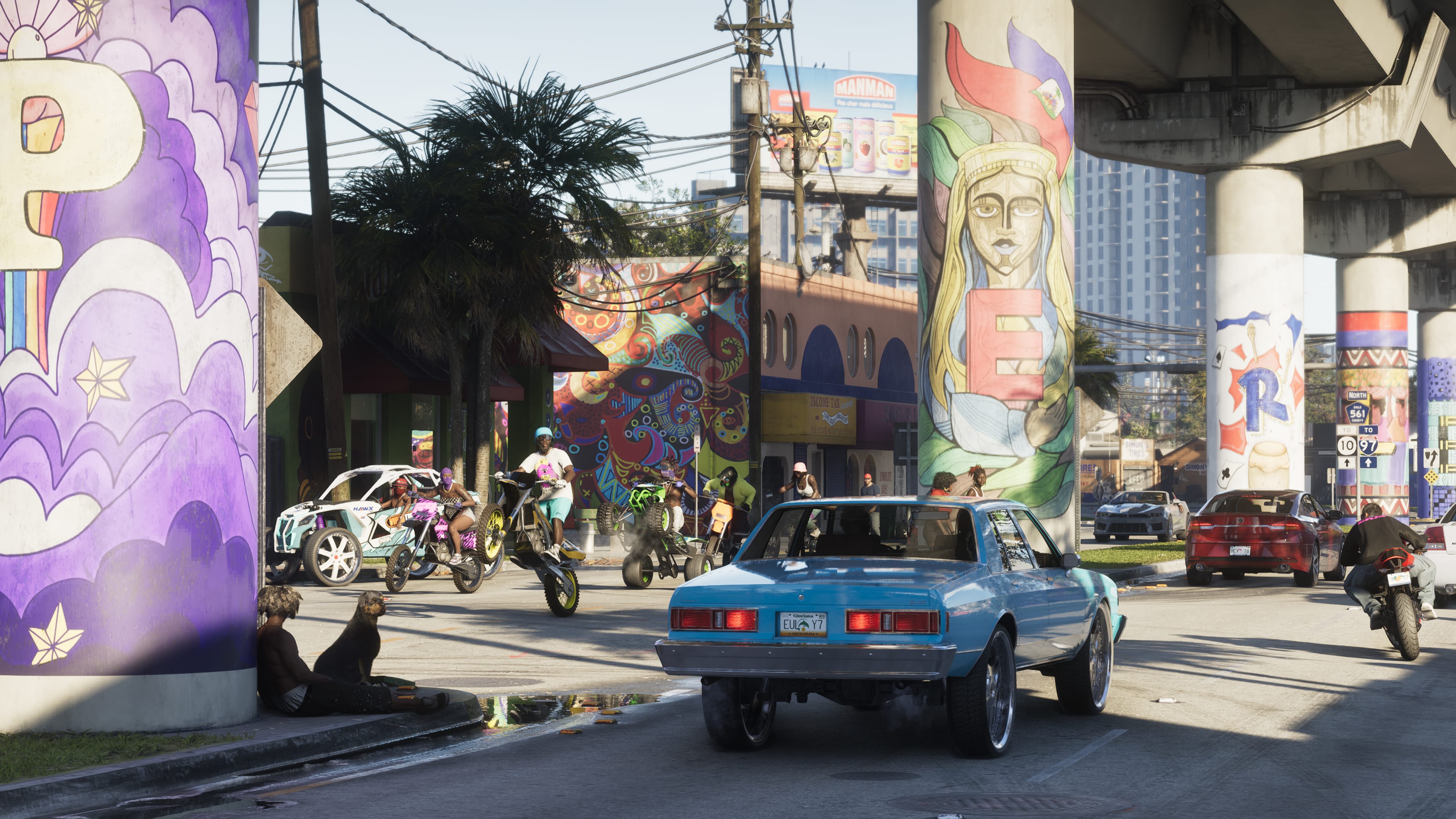
Miami itself is really those extremes—lovely people, incredible wealth, incredible poverty, excess, craziness, the hustle, and showing it all off. That’s our research trips—experiencing those extremes so that we can bring them into our world, and it all finds its way into the game in surprisingly direct ways.
KM Florida is a very visually diverse, stylistically loud place in America. When developing the characters, is that a gift or a curse? How do you channel all of this without it becoming a caricature, especially when working within all the different places (Vice City, Leonida Keys, Grass Rivers, Port Gellhorn, Ambrosia, and Mount Kalaga)?
MICHAEL KANE (Vice President of Art: Dynamic): It’s a blessing to be working from such a rich, real-life tapestry of reference in both the people and places of Florida. We approached the distinctions as we always do—with a deep dive on reference, staying in service to the story and keeping visual coherence with the world. We have to represent characters in some form of a visual shorthand, the crazy nuance we have engineered in clothing, styling, cosmetics and hairstyles—those fine details are hugely important for us to make our characters feel truly authentic, interesting, and diverse, and represent all the tones of Leonida.
KM GTA’s satire is very particular. It can be cutting, witty, and knowing in ways that always feel smarter than it lets on. When you’re inside the writers’ room, how do you keep that tone so sharp? Is there something about the distance of being British that helps you satirise America so deftly?
RUPERT HUMPHRIES (Senior Vice President of Narrative): Really we are led by what makes us laugh—what feels like a fresh take on something, and not the expected way to go. We want to surprise people, but in ways that feel true to the gritty, but also overblown, world we are creating. All the characters, from the billionaires to those down on their luck, should feel like they exist in the same tonal landscape and be affected by the same shared human weaknesses that make great targets for satire. We’ve just made a Western, where the main task is recreating a historical period; if you try and do that with a contemporary story, you’re just making the world that exists outside of your window—it’s not interesting. If you are going to put all this effort into creating a version of today’s world, it has to be more over the top, more insane, more in your face.
The other thing to keep in mind is the development time for this game; we work on it for years and years, so you need to make content that will feel vital to the moment of release. If there’s a trend blowing up for six months, you need to see it for what it is and not jump on the bandwagon. We took things that interested
us, like the conspiracy theories, the strange ways the public reacts to everyday occurrences, and those are the kinds of things we ran with. In most cases, rather than trying to put a like-for-like of something real in the world, we have created our own slanted, overblown versions, be that a conspiracy theory, or another universal contemporary phenomenon.
As for its Britishness, we still have a lot of Brits on the team, but there are Americans too, and everyone has the same, or a similar, sensibility about the sorts of jokes we need to make and the things we need to go after. At the same time, we are creating a place—Vice City and the larger state of Leonida—that we want people to spend hours of their lives in. You need to get inside the place, to fall in love with it, so you can tell the world why they want to come here. That’s definitely what we did with Miami and Florida on this project.
KM The American Dream has been a constant in the GTA world for decades. Has it collapsed, or just mutated into something you have to satirise differently now, and what is its new shape?
RH Some would say the American Dream collapsed a long time ago. With GTAIV we told an immigrant’s story that was supposed to be a kind of hollow commentary on the illusion of America as a land of opportunity, and then we sort of doubled down on that with the cynicism of GTAV. Maybe the American Dream is more modest now. It’s a house for your family and your loans paid off instead of wild success—but maybe today, that is just as out of reach for the average person. Miami and Southern Florida are a particular front line for this battle between astronomical wealth and unbounded ambition, creating a pressure cooker for all kinds of insanity.
KM In Grand Theft Auto VI, Jason’s arc—including his stint in the Army—could be read as a very specific class story. How much of Jason’s story was consciously written as one of failed social mobility, and what does it say about what America actually offers people like him?
RH We didn’t want to make any kind of statement with Jason’s backstory. It needs to be understood that he takes the measures he does—drug trafficking and becoming a bank robber, etc.—because of his material circumstances. But a lot of this is up to the player to decide whether he needs to do that, or if it’s a choice he makes because he’s wired differently from other people.
KM Lucia is Jason’s inverse as she almost seems like the engine, and he’s the brake. Was that contrast the starting point, or did it surface from writing them against each other?
RH Yeah, we needed the two characters to complement each other. To push and pull each other through the story, and this sort of came out of writing them together in scenes. Lucia had to be someone who wanted a better life for herself, and wouldn’t let the obstacles in the way of that life stop her getting it.
KM From a writing-room perspective, what do you focus on when writing a female lead in this genre who’s neither a victim nor a male fantasy, but a fully realised person with her own wants? And what were you determined to avoid to keep her free from cliché?
ELIZABETH GAUVEY-KERN (Game Writer): The actress who plays Lucia brought a lot to the character. A GTA protagonist
needs to be tough, badass, cool—and with this actress, we knew we could create an incredible Grand Theft Auto protagonist. We wanted both protagonists to be vulnerable, tough, flawed, right sometimes, wrong sometimes, able to learn from each other, and that’s what we felt made them authentic, and a great team.
ALEXA D’AGOSTINO (Game Writer): When it came to writing Lucia, I thought of the women I know—my mother was an immigrant who grew up in Newark, New Jersey, close to Lucia’s hometown of Liberty City. I thought about the way she raised me: rowdy, kind, but not to take any shit. I related a lot to Lucia and writing her came very naturally to me. There are many badass women like her, just as there are many men like Jason. We just focused on capturing that. When you are focusing on writing a fully realised person with their own wants, you’re going to get something perfectly imperfect—with clichés, but also undeniably real. That’s how you get a woman that can stand tall next to the likes of Arthur Morgan and Niko Bellic.
KM In what ways does Raul represent a different, but specific, side of Leonida’s underworld?
RH Something we felt strongly about with a Bonnie and Clyde-style narrative was that it’s a story about young people—they couldn’t be too experienced, or jaded. There is something hopeful and naive about going on the run and pushing a crime spree to its limit without worrying about the consequences. With that in mind, we needed an older mentor character to bring them into the large-scale heists and set pieces that you expect in a big action crime saga like this. We also wanted a character to embody Vice City, and bring a knowing Miami-cool into
the game. Raul embodies all the local and criminal knowledge that Jason and Lucia don’t have when they get to Vice City.
KM In Ambrosia, your fictional city inspired by Clewiston and Lake Okeechobee, there is a “Vote Erin Henshaw” sign with an Allied Crystals sponsorship or endorsement. Did you build Ambrosia’s politics as commentary on a specific American reality (the way real sugar country runs on a single corporation), and where’s the line between satire and simply holding up a mirror? How central is politics to GTAVI?
RH If you go back to the previous GTAs, there’s never really been much focus on national politics. The rise of Homeland Security and the Patriot Act were pretty central to GTAIV, but that was mainly because post-9/11 New York was a real frontline for those issues. Because we are trying to make games that feel very specific to the moment they are released but at the same time, not reflective of the exact world we live in, we don’t want to be too specific about any particular person, event, movement or anything like that.
Making a game in Florida though, there is so much to work with, and we have really tried to build out our world—filling it with all the characters and culture wars necessary to make it feel alive. And then we have so many ways to tell these stories outside of actually meeting characters face to face. You can see a sign for an election, receive a robocall from a campaign, or hear a commercial on the radio. And then we have some great political talk shows on the radio too where they discuss all these issues. Red Dead Redemption 2 was essentially a historical recreation, with a lot of the same tools we have used to make GTAVI; there is a big focus on not just holding up a mirror, but on making everything satirical, larger than life, and more grotesque. Otherwise, you could just go outside and live in the real world! We try to get to the heart of
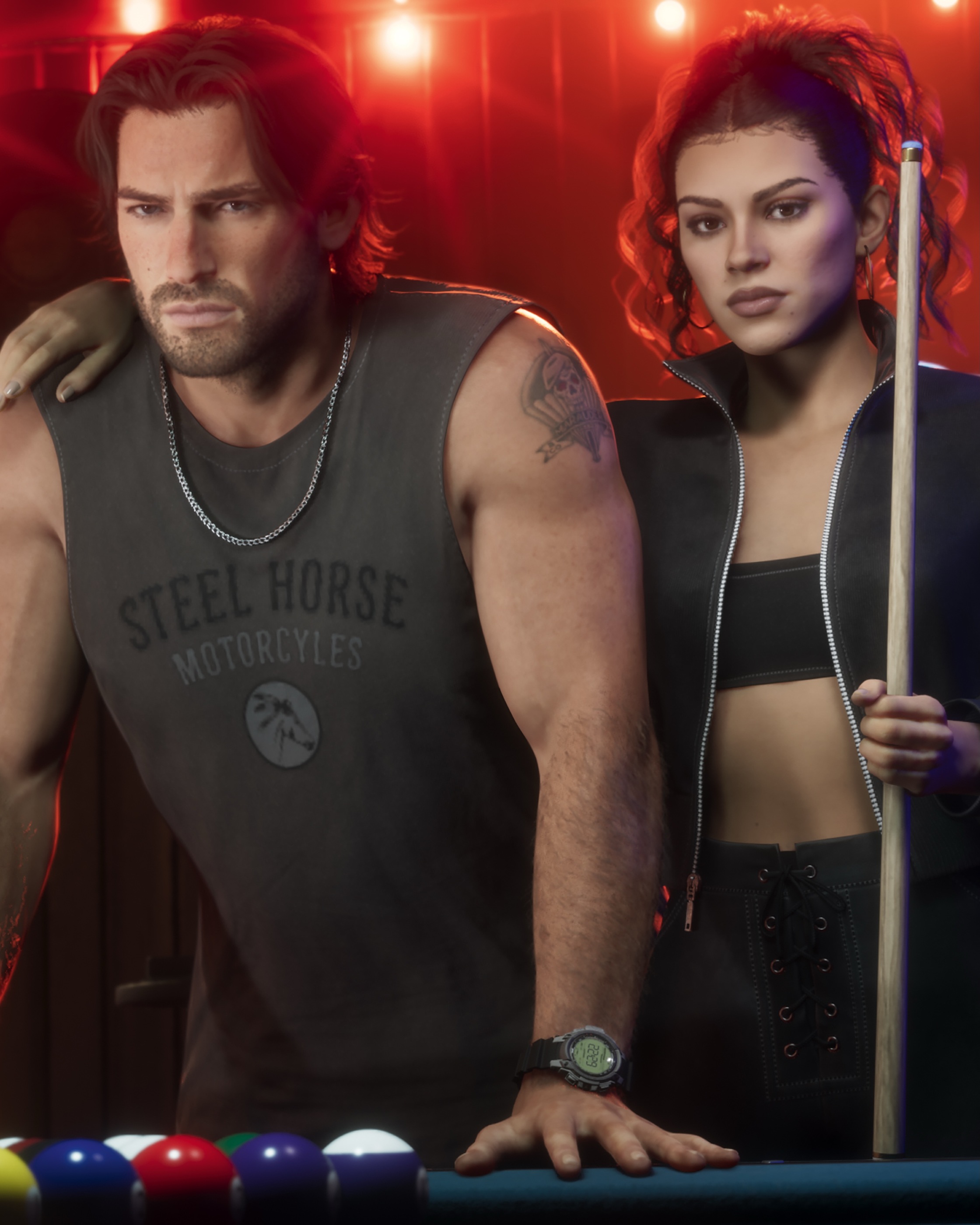
“There’s something hopeful and naive about going on the run and pushing a crime spree to its limit.”
whatever issue we want to talk about and then explode the part of it we find interesting until the ridiculousness of the position becomes really clear and hopefully funny, too.
KM The radio, the adverts, the overheard pedestrian dialogue. That texture within the game arguably does as much world-building as the main story. How do you approach writing this background noise so a city feels overheard rather than scripted?
RH We have brought together an amazing team of writers and creatives to make this game and all the “background noise” that makes the city and the world come to life. We have a specific team of pedestrian dialogue writers in LA and then a team of advertising and comedy writers across New York, LA, and London. It’s a team from all sorts of backgrounds and walks of life, but we all share a sense of humour and a desire to have a bit of fun with the ridiculousness of humans and the media and advertising. And none of us see it as background! It’s all part of the tapestry of the game and creates the experience of living in this wild world.
JAMES HORTON (Writing Director; Open World): We dreamed a lot bigger this time around. We started a new writing team in LA with pedestrian dialogue as their sole focus and sat them alongside a dedicated production team with the same mandate. There are no shortcuts when it comes to building a world like this: it’s a question of
giving the right people the resources they need to build something that’s not only vast and varied as a whole, but where every part rings true no matter how small it is, or how closely you look at it. It needs to wash over you when you’re sprinting down the busiest street in the city, hearing snatches of a hundred different conversations as you go; and it needs to be totally convincing if you decide to stop and pay close attention to any one of those conversations.
In a way, there is no “background” in this game: there’s just foreground you’re not paying attention to right now. Your agency and focus define what’s in the background, rather than the game doing it for you. If you shift your focus onto something new, it’s going to fill the frame, and it’s going to push back. No one you meet is an extra; they’re not only full characters, everyone you meet is the main character in their own story.
There are immense technical challenges in getting a world like that to work. The writing is not the only part of the system that meets those challenges—it’s profoundly technical writing—but it’s also the part that makes you forget you’re dealing with a system at all, and keeps you focused on your relationship with the world and the people in it. So, you need a team of people who can rise to that challenge in hundreds of different ways, in hundreds of different voices. That’s the key, really. No single writer could begin to attempt something on this scale. You need an ensemble team to make an ensemble world. ♥
GAME OF LIFE
From childhood escape to adult disillusionment, director
Djiby Kebe reflects on how the Grand Theft Auto series became
a way of understanding the world—and himself.
For me, video games matter just as much as books and cinema. Certain titles have shaped the way I think, politically and personally. Grand Theft Auto: San Andreas was my childhood, a fantasy of escape. Grand Theft Auto IV was adolescence and the onset of depression. Then came Grand Theft Auto V: a satire of contemporary life and social media that ultimately became, for me, a desperate attempt to heal.
GTA: San Andreas came out in 2004, when I was four years old. At home we had no toys, only my older brother’s PlayStation. In GTA: San Andreas, Carl ‘CJ’ Johnson returns home to Los Santos—a fictional city inspired by Los Angeles—to bury his mother, only to find his neighbourhood transformed and his gang scattered. The situation fuels his ambition and hunger for success. Set in 1992, the year of the LA riots, it’s a game about the streets, loyalty, and the American dream, as seen through the eyes of a Black American man. As a child, I didn’t have the maturity to play it seriously, yet driving around the streets of Los Santos listening to Rage Against the Machine and the Geto Boys marked me for life.
From the 1990s to the 2000s, the figure of the Black American man openly embracing ultra-capitalist ambition was a source of heated moral debate, while also becoming part of the mainstream imagination. France, where I grew up, showed no interest in people like me, people of African descent; instead they celebrated the faces of African-American actors, musicians, and athletes. It made me believe that to be accepted in my country, I had to look like these celebrities, sound like them, and want what they wanted. Playing GTA: San Andreas was the closest I could get to that world.
In 2008, on the boulevard in my neighbourhood, I spotted an enormous billboard featuring Niko Bellic, the protagonist of GTAIV. I was surprised; he struck me as much less appealing than CJ. He was white, sported a corny haircut and, above all, had a cold stare. When the game came out, I was eight years old and beginning to realise that the world we live in is full of hardship. When I played
it for the first time, I was surprised to find Liberty City—the game’s fictionalised version of New York City, a city which films had made me dream about—was painted in such a raw, unforgiving light. Gone was the bright sprawl of San Andreas; in its place was the grit of Broker, modelled on Brooklyn. All of this was less glamorous, and yet GTAIV is the game that, alongside my growing obsession with politics, defined me. For the first time in my life, I came face to face with something that has never left me: depression.
GTAIV is a depressing game for the depressed. Its characters endure life rather than live it. Dwayne Forge is one of them. A Black man in his thirties, he gets out of prison to find the world is no longer the same. The people he loved have betrayed him. That feeling of abandonment is something he shares with Niko Bellic. Before setting foot in the United States, Niko fought in the Yugoslav Wars, witnessed atrocities, and narrowly escaped death after an ambush on his regiment where 12 members of his unit were killed. He later learned one of his comrades had betrayed them, and this man was now living in Liberty City. It was one of the reasons he crossed the Atlantic. Dwayne and Niko carry the same sense of betrayal and, in a place like Liberty City, where individualism reigns, the two men form a friendship out of necessity. Their shared experiences lead them to lean on each other.
Where the cast of characters in GTA: San Andreas retained a semblance of light, in GTAIV, that is gone entirely. What makes the game compelling and relevant is its unflinching portrayal of the violence of big cities and modernity. Playing it at eight years old, I was moved without quite understanding why; today, Niko and Dwayne remind me of myself. The pressure to make money and escape poverty weighs on my shoulders. I recognise this in everyone I grew up with: it is the illness of the 21st century. Out of pragmatism and cynicism, I have learned to accept it, to live with it as best I can. It’s a comedy I hope will not run for too long. The world collapses, but I act as though everything is fine. I consume endlessly and travel
whenever I can. Like the characters in GTAIV, once the story is over, all that remains is to spend money and move through the city in luxury vehicles, all the while carrying the sadness within us.
Unlike all previous instalments, 2013’s GTAV, which marks a return to Los Santos, depicts a world in transformation. Smartphones and social media enter the picture, and we see just how much they influence the lives of the characters. As the story unfolded, your trajectory was commented on in real time across the networks. Franklin Clinton, Michael De Santa, and Trevor Philips are completely dysfunctional individuals. They hurt the people around them, who, in revenge, post about their faults on the game’s own social networks: Lifeinvader (a caricature of Facebook) and Bleeter (a caricature of Twitter, now X).
As private individuals, Franklin and Michael enjoy immense fortunes and drive the finest cars; as a player, you feel as if you’re controlling accomplished individuals. That illusion shatters the moment you pull out your smartphone and see what’s being said about them in public. Criticised by those around him, who feel he looks down on them, Franklin decides to leave the hood, going so far as to abandon his family and friends. Michael, in an attempt to understand his malaise, begins therapy.
Social media in GTA is brutal, stupid, and unforgiving. By pushing satire to its limits, it portrays a world obsessed with likes and engagement. The characters of GTAV, like all of us who came of age online, attempt to heal themselves—whether through flight or introspection. Thirteen years on, the world hasn’t changed: it has simply accelerated its own decay. Countless social networks have emerged, our dependence on smartphones has grown, and the cost of living keeps rising. We’re driven to work without respite. It is hard not to adopt a cynical posture in the face of it all.
Rockstar Games has a knack for exposing the absurdity of the age. I’m waiting for the next instalment, Grand Theft Auto VI, due in November, if only to better understand the world we live in. ♥